
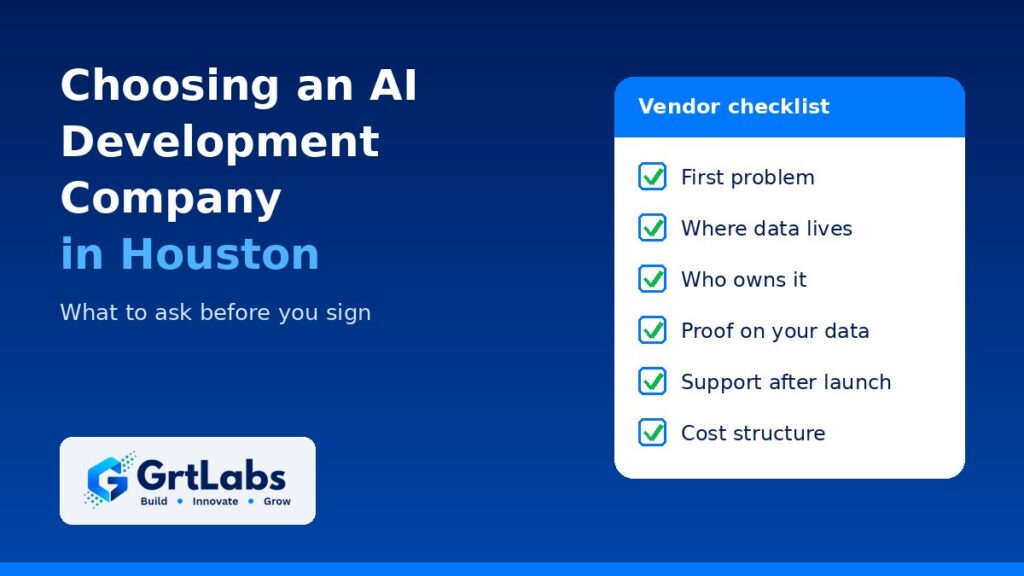
Choosing an AI Development Company in Houston: What to Ask Before You Sign
Choosing an AI Development Company in Houston: What to Ask Before You Sign https://grtlabs.com/wp-content/uploads/2026/10/featured-choosing-ai-development-company-houston-1024x576.jpg 1024 576 Nadeem Shaikh https://secure.gravatar.com/avatar/459d5135d86aff60790fdf4d25ee6958e526211d5cd43d190b1516158cf9feba?s=96&d=mm&r=gBefore you sign with an AI development company in Houston, get clear, written answers on five things: which problem they will solve first, where your data will live, who owns what they build, how they will prove it works on your real data, and who runs it after launch. A good partner answers all five in plain words. A vague answer to any of them is a warning sign, no matter how good the demo looked.
Plenty of firms in Houston now offer AI. The hard part is telling a team that can ship a working system inside your business from one that can only show a polished prototype. The questions below work for any vendor, local or remote, and they are the same questions we expect buyers to ask us.
1. Start with the problem, not the technology
The first conversation should be about your process, not about model names. Ask:
- What problem would you solve first, and how will we measure it? Hours saved, errors avoided, faster replies to customers: something you can count.
- Have you built something like this before, and can you show it? Ask for a walkthrough of real work, not slides.
- Would you tell us if AI is the wrong tool? Some problems are better solved with a simple automation, a report or a process change.
A good sign is a vendor who asks about your documents, systems and exceptions before proposing anything. A warning sign is a proposal that leads with “AI transformation” and never names a specific workflow. If you are still deciding between buying a tool and building one, our guide to off-the-shelf AI vs custom AI can help.
2. Ask where your data goes
This is the question that matters most for companies in healthcare, energy, finance and any business with customer records. Ask:
- Will our data stay inside our own AWS or Azure account, or pass through yours?
- Which model providers will see our prompts and documents, and do their terms allow them to train on that data?
- Will the AI respect our existing permissions, so nobody sees documents they could not already open?
- Can it run on a self-hosted model if our privacy rules rule out outside AI services?
- How will you protect it against prompt injection and other misuse?
If the system will answer questions from your documents, ask how retrieval works and how answers cite their sources. Our RAG explainer covers what good looks like.
3. Ask who owns what you pay for
Ownership gets messy when it is not written down. Ask who owns the code, prompts, configuration, data pipelines, any fine-tuned models and the documentation. Then ask the follow-up: if we part ways, can another team pick this up and run it? Watch for systems built on a vendor’s own closed platform that you can only keep using by paying them. Whatever the answer, put it in the contract.
4. Ask how they will prove it works
A demo on the vendor’s sample data proves very little. Ask:
- Will the proof of concept use our real documents and data?
- What does success look like, agreed before the build starts? For example, an accuracy target on a test set, or time saved per task.
- How do you test answers, and where do people review the output before it is trusted?
- What happens if the proof of concept misses the target?
A short discovery phase before any build is the cleanest way to get these answers. Our AI readiness assessment guide lists what that phase should cover.
5. Ask how it runs after launch
AI systems need care after go-live: models change, documents change and usage grows. Ask who monitors quality and errors, how cloud and model costs are tracked and capped, how model updates are tested, and who you call when something breaks. For agents that take actions, ask whether every action is logged so you can review it later, as we describe in AI agent audit trails. Our LLMOps guide covers the day-to-day side in more detail.
Also ask what handoff looks like: documentation, training for your team, and whether you can run it yourselves if you choose to.
6. Ask about cost the right way
Any honest vendor will struggle to quote a full AI build before seeing your data and systems. Instead of asking for one number on the first call, ask how pricing is structured (a fixed discovery phase, time and materials, a monthly support plan), what drives ongoing cloud and model usage costs and who pays them, and what support includes. Then ask for a written estimate once discovery is done, when it can be based on real scope.
Red flags to watch for
- Accuracy or savings promised before anyone has looked at your data.
- No mention of human review where a mistake would be costly.
- Unclear answers about where your data goes or which AI providers see it.
- A closed platform with no way to take your system elsewhere.
- Demos only on the vendor’s own sample data.
- No plan for monitoring, support or handoff after launch.
Does it matter if the AI company is in Houston?
Local is not a reason on its own to pick a vendor; the answers above matter more. But a Houston-based team does make some things easier: discovery workshops can happen in person at your office, meetings and fixes happen on Central Time, and the team is more likely to know the documents and systems common in Houston industries such as energy, healthcare, construction and logistics. A remote team that answers every question well is still a better choice than a local one that does not.
A checklist to bring to your first call
- Which problem will you solve first, and how will we measure it?
- Where will our data live, and which AI providers will see it?
- Who owns the code, prompts, pipelines and models?
- Will the proof of concept use our real data, with success agreed up front?
- Who monitors, supports and pays for running it after launch?
- How is pricing structured, and when will we get a written estimate?
How GrtLabs answers these questions
GrtLabs is a Houston AI lab and software company at 10101 Southwest Fwy #431. We usually start with AI Discovery, a focused 2–3 week engagement where we review your data, systems and processes, rank use cases by value and feasibility, and give you build or no-build recommendations with a roadmap that is yours whether or not you build with us. When we build, we deploy inside your own AWS or Azure account with access controls you own, plus monitoring, logging and cost budgets, and we document the system and train your team to run it. See what we build and how an engagement works on our AI development company in Houston page.
Comparing AI vendors in Houston? Bring this checklist to us too. Talk to our team about your first use case, or start with AI Discovery.
Frequently asked questions
What should a Houston business ask an AI development company before signing?
Ask which problem they will solve first and how it will be measured, where your data will live and which AI providers will see it, who owns the code and models, how the proof of concept will be tested on your real data, and who monitors and supports the system after launch. Get the answers in writing.
How long does it take to know if an AI project will work?
Usually a few weeks. A short discovery phase picks the right first use case, and a proof of concept on your own data shows whether it meets the success target you agreed up front. At GrtLabs, AI Discovery typically takes 2–3 weeks.
How much does it cost to hire an AI development company?
It depends on the use case, the data involved and the systems that need to connect, so an honest vendor will not quote a full build before seeing them. Ask how pricing is structured, what ongoing cloud and model costs to expect, and for a written estimate after discovery.
Do I need a local AI development company, or can I hire a remote one?
Either can work. A local Houston team makes in-person workshops and same-time-zone support easier, but clear answers on data, ownership, testing and support matter more than location.
