
Posts By :

Nadeem Shaikh

Wooden chess pieces lined up on a chessboard representing strategy and controlled decisions
AI Agent Governance: How to Let AI Agents Do Real Work Without Losing Control
AI Agent Governance: How to Let AI Agents Do Real Work Without Losing Control 1024 576 Nadeem Shaikh

AI agent governance means deciding, before an agent goes live, what it may do on its own, what needs a human yes, and how every action gets logged and reversed. If you can’t answer those three questions for an agent, it isn’t ready to touch real orders, invoices or customer records.

This week the big platforms made the same point. SAP, ServiceNow, IBM and SAS all announced agent features built around audit trails, agent inventories and controls on how much autonomy an agent gets. The tools are new, but the rules behind them are simple enough for any business to apply, whatever stack you run.

Why AI agents need governance and chatbots didn’t

A chatbot answers a question. An agent takes an action: it updates a CRM record, approves a refund, routes a purchase order or sends a file to a vendor. When an answer is wrong, someone reads it and moves on. When an action is wrong, money moves, data changes or a customer gets the wrong message.

That’s the whole reason governance matters. The more an agent can do, the more you need to know what it did, why, and how to undo it.

The five controls every AI agent should have

1. A written scope

List the systems the agent can read, the systems it can write to, and the actions it is allowed to take. Anything not on the list is off limits. Keep it to one page so the business owner, not only the developer, can sign it.

2. Its own identity and least-privilege access

Give the agent its own account instead of borrowing a person’s login or an admin API key. Grant only the permissions its scope needs. If the agent is compromised or misbehaves, you can switch off that one identity without locking out a team.

3. Autonomy levels by action

Not every action carries the same risk. A practical split:

  • Act on its own: reading data, drafting replies, tagging and routing tickets.
  • Act, then report: low-value, easily reversed updates, such as correcting a field in a CRM record.
  • Ask first: anything that spends money, changes a contract, deletes data or reaches a customer.

Start strict and loosen a rule only after the agent has a clean track record on it.

4. A full audit trail

Log every input, every tool the agent called, every decision and every result, with a timestamp. When someone asks why an order was changed, you should be able to answer in minutes, not after a week of digging.

5. An off switch and a rollback plan

Someone on your team should be able to pause the agent in one step. For each write action, know how you would reverse it, whether that’s a database revision, a credit note or a follow-up message.

Keep an inventory of every agent you run

Agents multiply fast. One team builds an email triage agent, another turns on an assistant inside their ERP, a third wires up an automation through a no-code tool. Within a year nobody knows how many there are or what they can touch.

A simple inventory fixes that. For each agent, record its owner, its purpose, the systems it touches, its autonomy level, the AI model it uses and the date it was last reviewed. A shared spreadsheet is fine to start.

Test agents before and after they go live

Before launch, run the agent against a set of real past cases where you already know the right outcome, and check what it gets wrong. After launch, keep sampling its work. Models change, data changes and prompts drift, so an agent that was accurate in month one can quietly get worse by month six.

Where to start if you already have agents running

  1. List every agent and automation that can write to a business system.
  2. For each one, check whether it has its own identity and a log of its actions.
  3. Move every action that spends money or contacts customers to “ask first” until you’ve reviewed it.
  4. Name one owner per agent who is responsible for its results.

None of this needs a new platform. It needs clear rules, applied consistently.

Build agents that are governed from day one

GrtLabs designs and builds AI agents with scope, permissions, approval steps and logging built in, inside your own AWS or Azure account. See how we approach it on our Agentic AI page, or contact us to talk through the agent you want to put to work.

The Benefits of Snowflake and New Generative AI: Making Data Management More Powerful
The Benefits of Snowflake and New Generative AI: Making Data Management More Powerful 1024 576 Nadeem Shaikh

The Benefits of Snowflake and New Generative AI: Making Data Management More Powerful

In the evolving landscape of data management and analytics, Snowflake and new generative AI technologies are transforming how organizations handle and leverage their data. These advancements are not just incremental improvements; they represent significant leaps forward in efficiency, scalability, and innovation. This article explores the benefits of Snowflake and how new generative AI technologies are enhancing its capabilities, making it a powerhouse for modern data needs.

Snowflake: A Game-Changer in Data Warehousing

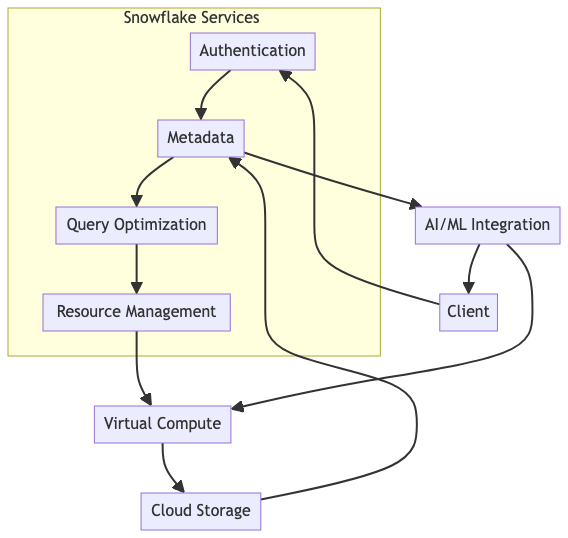
Snowflake has revolutionized data warehousing with its unique architecture and cloud-based solutions. Here are some of the key benefits that make Snowflake a preferred choice for organizations worldwide:

  1. Scalability and Performance
  • Snowflake’s architecture separates storage and compute resources, allowing for independent scaling. This means that businesses can handle massive amounts of data and numerous concurrent queries without a drop in performance.
  • The platform automatically optimizes data storage and retrieval, ensuring fast query performance regardless of the data volume.
  1. Seamless Data Integration
  • Snowflake supports a wide range of data formats and easily integrates with various data sources, from structured to semi-structured data like JSON and Avro.
  • It offers robust data sharing capabilities, enabling secure and efficient sharing of live data across different departments and organizations without the need for data duplication.
  1. Cost Efficiency
  • With its pay-as-you-go pricing model, Snowflake ensures that organizations only pay for the resources they use. This model provides significant cost savings, especially for businesses with variable workloads.
  • Automated scaling and resource management further optimize costs by eliminating the need for over-provisioning.
  1. Data Security and Governance
  • Snowflake provides comprehensive security features, including end-to-end encryption, robust access controls, and compliance with industry standards like GDPR and HIPAA.
  • It also offers powerful data governance tools that help organizations maintain data quality and compliance, ensuring that data is reliable and secure.

Enhancing Snowflake with Generative AI

Generative AI, a subset of artificial intelligence that can generate new content, ideas, and solutions, is making Snowflake even more powerful. Here are some ways in which generative AI is enhancing Snowflake’s capabilities:

  1. Advanced Analytics and Insights
  • Generative AI models can analyze vast amounts of data to uncover hidden patterns and insights that traditional methods might miss. This capability allows businesses to make more informed decisions and gain a competitive edge.
  • By integrating generative AI with Snowflake, organizations can automate complex data analyses, reducing the time and expertise required to extract valuable insights.
  1. Automated Data Cleaning and Preparation
  • One of the most time-consuming tasks in data management is cleaning and preparing data for analysis. Generative AI can automate these processes, identifying and correcting errors, filling gaps, and standardizing formats with minimal human intervention.
  • This automation improves data quality and accelerates the time-to-insight, allowing analysts to focus on higher-value tasks.
  1. Enhanced Data Personalization
  • Generative AI enables hyper-personalization of data-driven applications, from marketing campaigns to customer service solutions. By leveraging AI-generated insights, businesses can create highly personalized experiences for their customers, increasing engagement and satisfaction.
  • In combination with Snowflake’s data sharing and integration capabilities, personalized data can be seamlessly and securely delivered to the right stakeholders.
  1. Predictive Maintenance and Optimization
  • Generative AI can predict future trends and potential issues by analyzing historical data. This predictive capability is invaluable for maintenance, risk management, and operational optimization.
  • When integrated with Snowflake, these AI-driven predictions can be immediately acted upon, ensuring that businesses stay ahead of potential challenges and opportunities.

Conclusion

Snowflake and generative AI are at the forefront of a data revolution, providing unparalleled capabilities for data management, analysis, and utilization. By combining Snowflake’s robust data warehousing solutions with the innovative power of generative AI, organizations can achieve greater efficiency, deeper insights, and more strategic decision-making.

For businesses looking to harness the full potential of these technologies, expert guidance is crucial. Contact GRTLABS experts, who possess advanced knowledge and skills in Snowflake and generative AI, to help you navigate this transformative landscape and achieve your data-driven goals.