
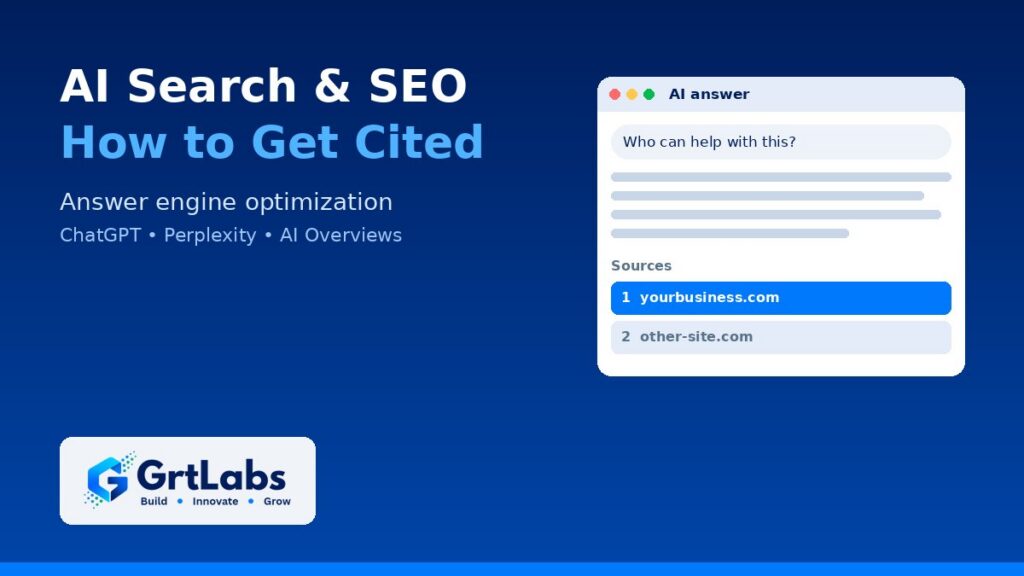
AI Search and SEO: How to Get Cited in ChatGPT, Perplexity and AI Overviews
AI Search and SEO: How to Get Cited in ChatGPT, Perplexity and AI Overviews https://grtlabs.com/wp-content/uploads/2026/10/featured-answer-engine-optimization-1024x576.jpg 1024 576 Nadeem Shaikh https://secure.gravatar.com/avatar/459d5135d86aff60790fdf4d25ee6958e526211d5cd43d190b1516158cf9feba?s=96&d=mm&r=gAnswer engine optimization (AEO) is the work of making your content easy for AI search tools such as ChatGPT, Perplexity and Google’s AI Overviews to find, understand and cite. In practice it means answering real buyer questions directly near the top of the page, structuring pages with clear headings and FAQ schema, making your business details consistent everywhere, letting AI crawlers reach your site, and publishing original content worth quoting. It builds on good SEO rather than replacing it.
More buyers now ask an AI tool a question before they ever click a search result. When that tool answers, it names a few sources. This guide covers what you can do so one of those sources is you, and how to tell whether it is working.
What is answer engine optimization (AEO)?
Traditional SEO aims to rank a page in a list of blue links. AEO aims to get your content used inside the answer itself: quoted, summarized or linked as a source when someone asks an AI assistant or sees an AI-generated summary at the top of a search page.
The two overlap heavily. AI search tools still have to find your pages, and many of them lean on regular search indexes to decide what to read. A slow, poorly structured site that does not rank well is unlikely to be cited either. What AEO adds is a sharper focus on the questions buyers ask, on answers that make sense when lifted out of the page, and on signals that help a machine trust who you are.
In broad terms, an AI search tool takes the question, retrieves pages that look relevant, and writes an answer from them, often with links. If you have read our guide to retrieval-augmented generation, it is the same idea applied to the open web. Your job is to make your page the easiest good source to retrieve and quote.
Step 1: Structure answers so they are easy to lift
AI tools pull passages, not whole pages. A passage that answers the question on its own is far more useful to them than a clever introduction that gets to the point in paragraph five.
- Lead with the answer. Put a direct two-to-four sentence answer right under the heading, then add detail.
- Use the question as the heading. Headings such as “How long does a website redesign take?” match how people phrase prompts.
- One topic per section. Keep each H2 focused, so a single section can stand alone.
- Use lists and steps for processes, comparisons and checklists. They are easy to scan for people and machines.
- Write plainly. Define terms the first time you use them and avoid vague marketing phrases that say nothing a tool could quote.
- Keep one H1 per page and a logical heading order underneath it.
Step 2: Add FAQ content and schema markup
A short FAQ at the end of a service page or article covers the follow-up questions buyers ask. Keep each answer to a few sentences that stand alone, and use questions real customers ask, from sales calls, support emails and Search Console queries.
Then add structured data. Schema.org markup in JSON-LD tells machines what a page is about in a format they do not have to guess at. Useful types for most businesses include:
- Organization or LocalBusiness on your homepage or contact page, with your name, address, phone, logo and social profiles.
- Service on service pages, describing what you offer and where.
- Article on blog posts, with the author and dates.
- FAQPage for genuine question-and-answer sections.
- BreadcrumbList so the place of each page in your site is clear.
Schema does not guarantee a citation, and the markup must match what is visible on the page. Its value is reducing ambiguity, which is exactly what AI tools need. Test it with Google’s Rich Results Test or the Schema Markup Validator before you publish.
Step 3: Make your business a clear entity
AI tools try to work out who a business is, what it does and whether other sources agree. If your name, services and location look different on every site, the picture gets blurry. Make it sharp:
- Use the same business name, address and phone number on your website, Google Business Profile, LinkedIn and directory listings.
- Describe your services in the same words across your site and profiles, so the connection between your brand and each service is obvious.
- Link your website to your official social profiles, and link those profiles back to your website.
- Add a real About page and author information, so readers and machines can see who stands behind the content.
For local businesses this overlaps with local SEO. A complete, accurate business profile helps both map results and AI answers to questions such as “who offers this service near me?”
Step 4: Let AI crawlers reach your content
If an AI tool cannot fetch your page, it cannot cite it. Check the technical basics:
- Review robots.txt. Many AI tools use their own crawlers, such as OpenAI’s OAI-SearchBot and GPTBot, PerplexityBot, and Google-Extended for some Google AI uses. Decide deliberately which you allow rather than blocking them by accident. Google’s AI Overviews draw on regular Google Search crawling, so blocking Googlebot removes you from both.
- Check your firewall and CDN. Security tools sometimes block bot traffic broadly. Make sure legitimate crawlers are not being turned away.
- Put important text in the HTML. Content that only appears after heavy JavaScript runs, or is locked inside images and PDFs, is harder for crawlers to read.
- Keep pages fast and indexable. Clean URLs, an up-to-date XML sitemap, correct canonical tags and no accidental noindex tags.
A clean site structure is the foundation here. If your current site makes this hard, our comparison of custom websites and templates explains when a rebuild is worth it.
Step 5: Publish original content worth citing
AI answers tend to blend many sources together. When ten sites say the same generic thing, there is little reason to name yours. Content that is cited usually adds something others do not have:
- Your own process, explained step by step, with the trade-offs you have learned from real projects.
- Original data, such as survey results or anonymized patterns from your own work, with the method explained.
- Clear definitions and comparisons in your field, kept accurate and up to date.
- Specific, honest answers to buyer questions about scope, timelines and how you work.
- Dated pages that you review and refresh when facts change.
Do not invent numbers or quotes to look authoritative. Inaccurate claims hurt trust with readers, and a wrong statement repeated by an AI tool under your name is worse than not being cited at all.
Step 6: Measure AI referrals and citations
AEO is newer than SEO and the measurement tools are still catching up, so combine a few signals:
- Referral traffic in analytics. In Google Analytics 4, look at sessions by source for referrers such as chatgpt.com, perplexity.ai, copilot.microsoft.com and gemini.google.com. Some tools also add a utm_source tag to links they send.
- Search Console. AI Overviews traffic is counted within regular web search results, so watch impressions and clicks for the queries your answer pages target.
- Manual prompt checks. Keep a list of the questions buyers ask, run them in the main AI tools each month, and note whether you are cited and which page is used.
- Ask new leads. Add “How did you hear about us?” to your contact form, with an AI assistant option.
- Track conversions, not only visits. A handful of AI referrals that turn into calls matters more than a spike in traffic that never converts.
Answers change from day to day and differ by user, so look for trends over weeks rather than reacting to a single result.
How GrtLabs can help
Our SEO and digital marketing team in Houston combines technical SEO, content, local search, social media and paid advertising into one plan. We start with a website SEO audit of your technical health, page structure, content and search visibility, then fix on-page issues such as titles, headings and internal links, write original content that answers your buyers’ questions, and improve your business profile and local citations. We track traffic, rankings, leads and conversions, and share plain-language reports.
If you want your own site to answer visitor questions the same way AI search does, our AI assistants answer from your approved content and pass qualified leads to your team.
Want to know how your site looks to AI search? Contact our Houston team for a website review, or see our SEO and digital marketing services.
Frequently asked questions
What is answer engine optimization (AEO)?
Answer engine optimization is the practice of making your content easy for AI search tools such as ChatGPT, Perplexity and Google AI Overviews to find, understand and cite. It focuses on direct answers to real questions, clear page structure, schema markup, consistent business information and crawlable pages.
Is AEO different from SEO?
AEO builds on SEO rather than replacing it. SEO aims to rank pages in search results, while AEO aims to get your content quoted or linked inside AI-generated answers. Both depend on a fast, crawlable site with useful, well-structured content.
How can I tell if ChatGPT or Perplexity is citing my website?
Check referral traffic in your analytics for sources such as chatgpt.com and perplexity.ai, run the questions your buyers ask in those tools each month and note which pages are cited, and ask new leads how they found you.
Should I block AI crawlers from my website?
It depends on your goals. If you want AI search tools to cite your pages, allow their search crawlers in robots.txt and your firewall. You can still block crawlers used only for model training if you prefer, so review each one deliberately.
