
RAG vs Fine-Tuning: Which Approach Fits Your Company Knowledge?
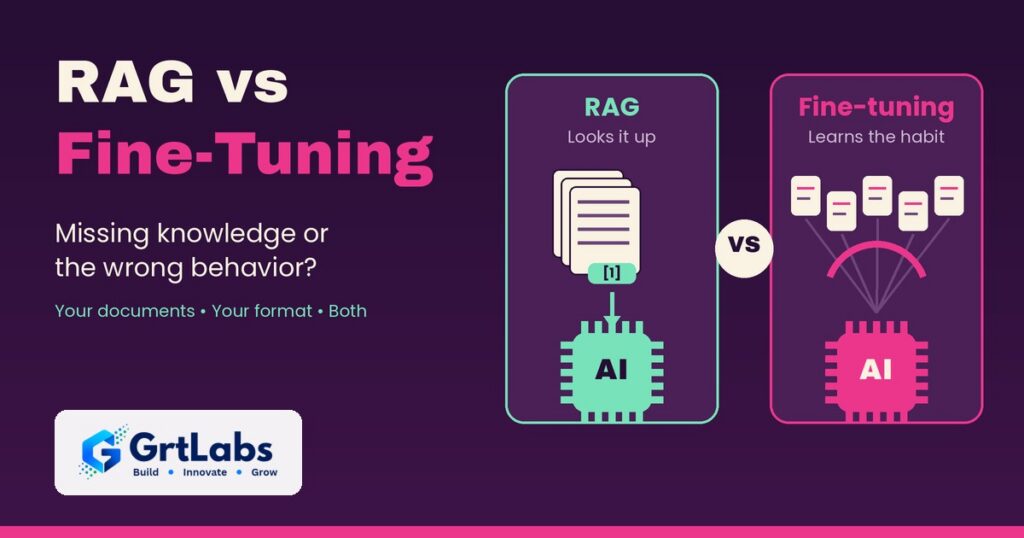
RAG vs Fine-Tuning: Which Approach Fits Your Company Knowledge? https://grtlabs.com/wp-content/uploads/2026/10/featured-rag-vs-fine-tuning-1024x538.jpg 1024 538 Nadeem Shaikh https://secure.gravatar.com/avatar/459d5135d86aff60790fdf4d25ee6958e526211d5cd43d190b1516158cf9feba?s=96&d=mm&r=gRAG vs fine-tuning comes down to one question: is your AI missing knowledge, or is it behaving the wrong way? RAG (retrieval-augmented generation) looks up the right passages in your own documents at the moment a question is asked and answers from them, with sources. Fine-tuning retrains a model on a set of example inputs and outputs so it learns a fixed style, format or task. If you want an AI that knows your policies, products and contracts, start with RAG. Add fine-tuning only when the model already has the facts but keeps answering in the wrong shape.
A request to "train an AI on our data" is often a knowledge problem in disguise: the team wants answers grounded in documents that change every month, limited to what each employee may see. Fine-tuning does not do that well. Here is how the two compare, when each one wins, and why many systems use both.
What is RAG?
Retrieval-augmented generation connects a language model to a search index of your content. When someone asks a question, the system searches your documents, wikis and knowledge bases, pulls the most relevant passages and hands them to the model along with the question. The model then writes an answer based on those passages and links back to where they came from. For a longer walkthrough, read our guide RAG explained: how AI can answer from your own company documents.
Cloud platforms now package this as a service. Amazon Bedrock Knowledge Bases searches your data at query time, can include citations and, on its managed option, filters results by document-level permissions. Azure AI Search offers security trimming so users only retrieve content they are authorized to see.
The key point for a business: the knowledge stays in your documents, not inside the model. When a policy changes, you re-index the document. Nothing has to be retrained.
What is fine-tuning?
Fine-tuning takes a model that has already been trained and continues training it on your own examples. Microsoft’s Foundry fine-tuning overview puts it simply: it adjusts the model’s weights rather than adding examples to each prompt. You give it pairs of inputs and ideal outputs, and the model learns the pattern.
OpenAI’s model optimization guide says fine-tuning can make a model format responses consistently, allow shorter prompts, and train a smaller, cheaper model to do one task well. Amazon Bedrock offers supervised fine-tuning, reinforcement fine-tuning and distillation, where a large "teacher" model trains a smaller "student" model.
What fine-tuning is not good at is keeping facts current. Microsoft’s own documentation says fine-tuning "doesn’t replace retrieval for current information or application-level safety controls."
RAG vs fine-tuning: side-by-side comparison
| RAG | Fine-tuning | |
|---|---|---|
| What it changes | What the model can look up at answer time | How the model behaves, through new weights |
| Best for | Facts, policies, product details, documents that change | Format, tone, classification and repeatable tasks |
| Keeping content current | Re-index the changed document | Collect new examples and retrain |
| Shows its sources | Yes, answers can cite the passages used | No, the knowledge is blended into the model |
| Access control | Can filter results by each user’s permissions | What it learned can surface for any user |
| What you need to start | Your documents and a search index | A set of clean, representative example pairs |
| Main costs | Indexing, search and longer prompts | Training runs, evaluation, hosting and retraining |
| Common failure | Retrieves the wrong passage or misses one | Learns from poor examples or drifts out of date |
OpenAI’s guide to optimizing LLM accuracy uses an exam analogy that fits well. RAG is like taking the test with the textbook open: the model looks up what it needs. Fine-tuning is like attending class for months: the model has seen so many examples that the behavior becomes learned memory. The same guide notes that many of OpenAI’s largest customer deployments used only prompt engineering and RAG.
When RAG is the better choice
- Your answers depend on documents. HR policies, SOPs, product manuals, contracts, support articles and price sheets are knowledge problems, which is what RAG solves.
- The content changes often. New policies, new products and updated procedures go live as soon as they are indexed.
- People need to check the answer. Citations let users click through to the source.
- Not everyone can see everything. A finance document should not show up in an answer for someone outside finance. Retrieval can respect existing permissions; a fine-tuned model cannot unlearn what it saw in training.
- You want to start quickly. You can begin with documents you already have, with no training set.
That is why internal assistants usually start with retrieval; see our post on building an internal AI assistant for HR and IT.
When is fine-tuning better than RAG?
Fine-tuning wins when the problem is behavior, not knowledge. OpenAI’s accuracy guide describes the signs: the model gives inconsistent results with the wrong formatting, uses the wrong tone or style, or does not follow the reasoning steps you need. Good cases include:
- Strict output formats. Turning messy notes into the exact fields your system expects, every time.
- Classification and routing. Sorting tickets, emails or documents into your own categories, using labeled past examples.
- A house style. Replies that must follow a specific voice or structure that long instructions alone do not achieve.
- Smaller, faster models. Training a small model to do one narrow task well enough to replace a larger, more expensive one. Our guide to small language models covers when that trade-off makes sense.
- Shorter prompts at scale. Baking a long list of examples into the model can cut tokens and latency on every request.
Fine-tuning needs good data. OpenAI suggests starting with 50 or more quality examples that look exactly like what the model will see in production, then evaluating before adding more. Microsoft lists data quality, overfitting, repeated runs and retraining when a base model retires among the challenges.
A 2026 reality check on fine-tuning
Fine-tuning also depends on the platform you build on, and that can change. On its deprecations page, OpenAI says that since May 7, 2026, organizations that have never run fine-tuning cannot create fine-tuning jobs, and that active existing customers lose the ability to create new jobs on January 6, 2027. Fine-tuned models keep working for inference until their base models are deprecated.
Amazon Bedrock and Microsoft Foundry still document supervised and reinforcement fine-tuning, and open-weight models can be tuned on your own infrastructure. The lesson is portability. A RAG knowledge base keeps your knowledge in your documents and index, so you can swap the model underneath. A fine-tuned model is tied to one base model and must be retrained when it retires. Weighing platforms? See AWS Bedrock vs Azure OpenAI.
Using RAG and fine-tuning together
This is not always an either-or decision. OpenAI’s guide calls the two methods additive: RAG supplies the right context, and fine-tuning makes the model use it consistently. A common setup looks like this:
- RAG supplies the facts. The system retrieves the current, permitted passages for each question.
- A tuned model shapes the output. If the answers must follow a strict format, a model fine-tuned on examples that include retrieved context can follow it more consistently.
- Evaluations keep both honest. A fixed set of real questions with known answers runs before every change.
Two more options are worth checking before either one. If your reference material is small, Anthropic’s engineering team notes in its post on contextual retrieval that a knowledge base under about 200,000 tokens (roughly 500 pages) can go straight into the prompt, with no retrieval at all. And clear instructions with a few examples are often enough. OpenAI’s advice is to get as far as you can with prompting before reaching for RAG or fine-tuning. Our post on LLMOps covers how to run those evaluations once a system is live.
How to choose: 5 questions
Answer these for your use case:
- What goes wrong today? Wrong or missing facts point to RAG. Right facts in the wrong format or tone point to fine-tuning.
- How often does the content change? Weekly or monthly changes favor RAG, because re-indexing is faster than retraining.
- Do users need sources? If people must verify answers, you need retrieval with citations.
- Who is allowed to see what? Permission-sensitive content belongs in a retrieval layer that checks access, not inside a model’s weights.
- Do you have training examples? Without a set of clean examples that match real inputs, fine-tuning is not ready yet.
For most company knowledge projects, the RAG vs fine-tuning answer is RAG first, with fine-tuning later for specific tasks. Still deciding whether to buy or build? Read off-the-shelf AI vs custom AI.
How GrtLabs builds this
GrtLabs is a Houston AI and software development company, founded in 2019, that builds custom AI, agentic AI, RAG knowledge systems, AI automation, and web and app development, plus GRTforms, our own online form builder.
Our RAG knowledge systems give your team private, natural-language Q&A over your own documents, wikis and knowledge bases. We build connectors and ingestion pipelines for your sources, search tuned to your content, answers with source citations, and access control aligned with your existing permissions, delivered as a chat or search interface or an API for your own apps. Every build includes evaluation, monitoring and handover documentation, and we can run it on AWS or Azure AI services within your own cloud environment.
RAG is also the knowledge layer for the agents and assistants we build; see how to build a company AI assistant.
Not sure whether your project needs RAG, fine-tuning or both? Talk to our Houston team, or see our RAG knowledge systems.
Frequently asked questions
What is the difference between RAG and fine-tuning?
RAG retrieves relevant passages from your documents at the moment a question is asked and gives them to the model, so answers are grounded in current content and can cite sources. Fine-tuning retrains a model on example inputs and outputs so it learns a behavior, such as a format, tone or task. RAG adds knowledge; fine-tuning changes behavior.
When is fine-tuning better than RAG?
Fine-tuning is better when the model already has the knowledge it needs but behaves inconsistently: wrong output format, wrong tone, or unreliable classification. It also helps when you want a smaller, cheaper model to do one narrow task, or to replace long example-filled prompts that run on every request.
Is RAG cheaper than fine-tuning?
It depends on the workload. RAG has no training runs and updates by re-indexing, but retrieved text makes every prompt longer. Fine-tuning adds training, evaluation and hosting costs and must be repeated when data or the base model changes, but can shorten prompts.
Can you use RAG and fine-tuning together?
Yes. RAG supplies current, permitted facts, and a fine-tuned model makes answers follow a consistent format or style. Train the model on examples that include retrieved context, and run the same evaluation set before every change.
Does fine-tuning keep company data private?
Fine-tuning blends the training data into the model, and the model cannot check who is asking. RAG keeps knowledge in your documents and can filter results by each user’s existing permissions, which usually fits sensitive company content better.
Can GrtLabs build a RAG system for my company in Houston?
Yes. GrtLabs is a Houston AI and software development company that builds RAG knowledge systems with connectors to your document sources, answers with source citations, access control aligned with your permissions, and evaluation, monitoring and handover documentation.
