
Context Engineering: Why AI Agents Fail Without the Right Information
Context Engineering: Why AI Agents Fail Without the Right Information https://grtlabs.com/wp-content/uploads/2026/10/featured-context-engineering-1024x538.jpg 1024 538 Nadeem Shaikh https://secure.gravatar.com/avatar/459d5135d86aff60790fdf4d25ee6958e526211d5cd43d190b1516158cf9feba?s=96&d=mm&r=gContext engineering is the work of deciding what an AI agent sees at each step of a task: its instructions, the tools it may use, the facts and records it pulls in, and what it remembers from earlier steps. When an agent gives a wrong answer or takes the wrong action, the cause is usually missing, stale or noisy context, not a weak model. So if you are buying or building AI agents, context engineering is where most of the reliability comes from. Good context is small, current, relevant to the step and limited to what the user is allowed to see.
The term spread because agents now run for many steps, call tools and pile up history. Below: a plain definition, the four ways context goes wrong, the main fixes, and what to ask before you sign off on an agent project.
What is context engineering?
Every time a language model answers, it only knows two things: what it learned in training, and what is in its context window right now. The context window is everything sent to the model for that step. Anthropic’s engineering team defines context engineering as the set of strategies for curating and maintaining the optimal set of tokens (information) during inference, including everything that lands there outside of the prompt itself.
Harrison Chase of LangChain puts it in more practical terms in The rise of context engineering: building dynamic systems to provide the right information and tools in the right format, so the model can plausibly accomplish the task. Redis’s 2026 overview adds the production view: deciding what an agent should see at each step, including which facts, records and past interactions it should retrieve, delivered current enough to trust and fast enough for production.
The key words are each step. An agent loops: it reads, calls a tool, gets a result, decides and calls another tool. The context changes on every turn, so someone has to design what goes in and what stays out.
Context engineering vs prompt engineering
Prompt engineering is about wording: how to phrase instructions so the model answers well. Anthropic calls context engineering the natural progression of prompt engineering. A prompt is one part of the context; the rest is tools, retrieved documents, message history, memory and data from your systems.
- Prompt engineering asks: how should we word the instructions? It is mostly a one-time writing task.
- Context engineering asks: what does the model need to see right now, and what should we leave out? It runs on every step, so it is software you build, test and monitor.
Chase makes a useful point for buyers: as models get better, more agent mistakes come from the model not being given the right context than from the model itself. In his words, LLMs cannot read minds. Garbage in, garbage out.
What goes into an AI agent’s context
When you review an agent design, ask to see each of these pieces.
- Instructions. The agent’s role, rules, limits and when to stop and ask a person. New to agents? Start with What is agentic AI? and AI chatbot vs AI agent.
- Tools. The list of actions it may take and how each tool is described. Anthropic warns that one of the most common failures is a bloated tool set with overlapping tools: if a human engineer cannot say which tool fits a situation, the agent cannot either.
- Knowledge. Passages pulled from your documents, usually through RAG (retrieval-augmented generation), limited to what the user may see.
- Live business data. The current order, ticket or customer record, fetched when it is needed.
- History and memory. What happened earlier in this task, and notes saved from past work.
- Examples. A few clear examples of good output. Anthropic recommends a small set of diverse, canonical examples instead of a long list of edge-case rules.
Why more context is not better
Context windows now reach millions of tokens, so it is tempting to send everything. The research says no. In its Context Rot report (July 2025), Chroma tested 18 models, including GPT-4.1, Claude 4, Gemini 2.5 and Qwen3, and found that model performance degrades as input length increases, often in surprising and non-uniform ways, even on simple tasks.
Anthropic describes the same effect as an attention budget: every extra token uses some of it, so context should be treated as a finite resource with diminishing returns. Its guiding rule is to find the smallest possible set of high-signal tokens that gives the outcome you want. Less context also means lower cost and faster answers, because you pay for and wait on every token.
Four ways context goes wrong
LangChain’s guide to context engineering for agents and Splunk’s August 2026 guide to production agents both use four failure patterns named by Drew Breunig. Each has a different fix.
- Context poisoning: a wrong fact or hallucination gets into the context and keeps being referenced, so the error compounds. Fix: check facts before saving them as goals or notes, and let the agent re-fetch from the source.
- Context distraction: the context grows so long that the model leans on the history instead of reasoning about the task. Fix: summarize or trim older steps.
- Context confusion: extra material, such as unrelated documents or unused tools, nudges the answer the wrong way. Fix: retrieve less, and offer only the tools for this step.
- Context clash: two parts of the context disagree, such as an old policy and a new one. Fix: version your sources, drop superseded documents and keep data fresh.
Redis sums up the freshness problem in one line: an agent acting on stale data will act confidently and wrongly. Security belongs here too. Anything an agent reads, including emails, web pages and uploaded files, becomes part of its context, which is how prompt injection works.
The main context engineering techniques
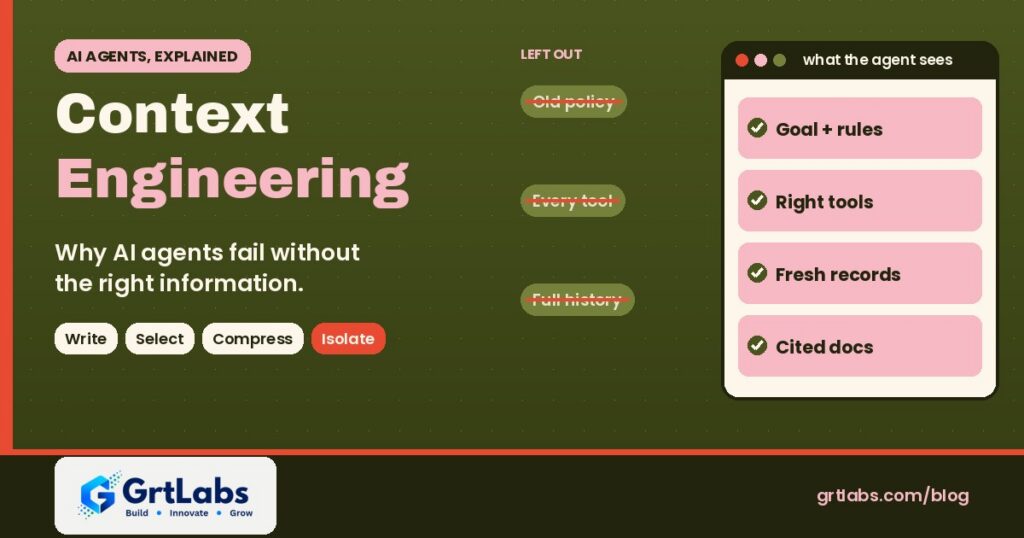
LangChain groups the techniques into four buckets: write, select, compress and isolate. In plain words:
- Write (save it outside the window). The agent keeps notes, a to-do list or a scratchpad outside the context and reads them back when needed. Anthropic calls this structured note-taking, or agentic memory.
- Select (pull in only what this step needs). Retrieve the few relevant passages, records or tools instead of everything. Anthropic describes a just-in-time approach: the agent keeps lightweight references, such as file paths, stored queries or links, and loads the data with tools only when it needs it.
- Compress (summarize and trim). When a long task nears the limit, summarize the history and continue from the summary. Anthropic calls this compaction and notes that clearing old raw tool results is one of the safest, lightest forms.
- Isolate (split the work). Give sub-tasks to separate agents with their own clean context, then combine the results. Splunk, which adds caching as a fifth pattern, notes that isolation suits read-only, parallel work like research and can cause trouble where steps depend on each other. See our post on multi-agent systems.
Where RAG and MCP fit
- RAG is the most common way to select knowledge: search your documents and pass only the relevant passages, with links to the sources. It is one part of the job, not all of it. Read RAG explained and RAG vs fine-tuning for when each fits.
- MCP, the Model Context Protocol, is an open-source standard for connecting AI applications to external systems. It gives agents a standard way to reach your tools and data. Every connected tool also adds descriptions and results to the context, so more connections are not automatically better. Our guide to a custom MCP server covers when to build one.
What context engineering means if you are buying an AI agent
You do not need to write the code, but ask how the vendor handles context. Good answers are specific.
- Where does each fact come from? Ask which systems and documents the agent reads, and whether answers show their source.
- How fresh is it? Live lookups, nightly sync or a one-time upload? Stale data is a common cause of confident wrong answers.
- Who can see what? Retrieval should respect each user’s existing permissions.
- Which tools are available at each step? A short, clearly described tool list beats dozens of overlapping tools.
- What happens on long tasks? Ask how history is summarized or trimmed, and what is kept.
- Can you see the context that led to an action? Logs should show what the agent saw and did, so a bad decision can be traced. See AI agent audit trail.
- How is it tested? Ask for tests on your own real examples before launch and monitoring after. Our LLMOps guide explains the after-launch side.
Common mistakes
- Blaming the model first. Before you pay for a bigger model, check what the agent actually saw on the failed step.
- Stuffing the context. A million-token window is not a reason to send a million tokens.
- Too many tools. Offer only the tools a step needs, each with a plain description.
- Trusting everything it reads. Treat emails, web pages and uploaded files as untrusted input.
- No owner for the knowledge. If nobody updates the documents behind the agent, its answers drift out of date.
- Skipping governance. Context decides what the agent knows; permissions and approvals decide what it may do. You need both. See AI agent governance.
How GrtLabs helps
GrtLabs is a Houston, Texas AI and software development company, founded in 2019, that builds custom AI, agentic AI, RAG, AI automation, and web and app development. Our Agentic AI work starts by agreeing on the agent’s goal, the tools it may use, its permissions and its escalation rules, then testing it against real examples with your team and deploying with human-in-the-loop approval steps and logging. Our RAG Knowledge Systems give agents and AI Assistants answers that cite their sources and respect who is allowed to see what, and our AWS and Azure AI team can run it inside your own cloud account.
Not sure where to start? Our AI Discovery engagement helps select the right first proof of concept, and AI automation may be enough where every step is the same. We also build GRTforms, our own drag-and-drop form builder with an AI builder, which is a simple way to collect clean, structured requests for an agent to work from. Working with a team in Texas? Meet our AI development company in Houston.
Want an AI agent that sees the right information at every step? Talk to our Houston team about your use case.
Frequently asked questions
What is context engineering in AI?
Context engineering is designing what an AI model or agent sees at each step of a task: its instructions, available tools, retrieved documents, live business data and memory of earlier steps. The goal is the smallest set of relevant, current information that lets the model do the step well.
What is the difference between context engineering and prompt engineering?
Prompt engineering is about how to word the instructions. Context engineering covers everything else the model sees as well, such as tools, retrieved documents, history and data from your systems, and it runs on every step of an agent’s work, so it is built and tested like software.
Why do AI agents fail even with a good model?
Most often because the context is wrong: information is missing, out of date, too long, contradictory or not allowed for that user. Research such as Chroma’s Context Rot report found that model performance degrades as input length grows, so sending everything does not fix it.
Is RAG the same as context engineering?
No. RAG is one context engineering technique: it searches your documents and passes only the relevant passages to the model. Context engineering also covers instructions, tool choice, memory, summarizing long histories and keeping data fresh.
What is context rot?
Context rot is the drop in accuracy that happens as the amount of text sent to a model grows. Chroma’s 2025 study of 18 models found performance becomes less reliable as input length increases, even on simple tasks, so long contexts need to be curated.
Can GrtLabs build AI agents with good context engineering in Houston?
Yes. GrtLabs is a Houston AI and software development company, founded in 2019, that builds agentic AI, RAG knowledge systems, AI assistants and AI automation, with permissions, approval steps and logging. Contact the team at grtlabs.com/contact to discuss your use case.
