
Claude Sonnet 4.5 Retirement: What to Check Before Nov 30
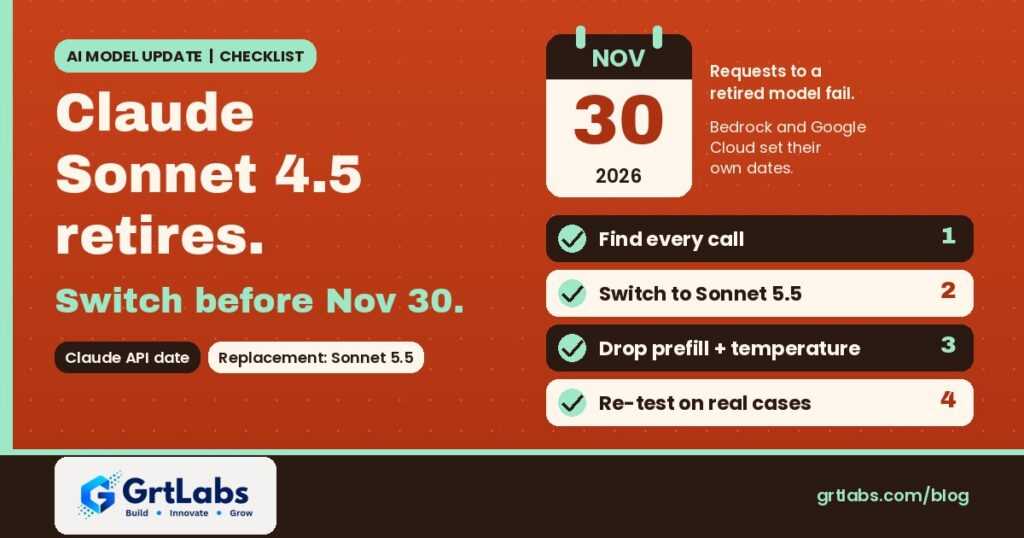
Claude Sonnet 4.5 Retirement: What to Check Before Nov 30 https://grtlabs.com/wp-content/uploads/2026/11/featured-claude-sonnet-4-5-retirement-1024x538.jpg 1024 538 Nadeem Shaikh https://secure.gravatar.com/avatar/459d5135d86aff60790fdf4d25ee6958e526211d5cd43d190b1516158cf9feba?s=96&d=mm&r=gWhat does the Claude Sonnet 4.5 retirement mean for your business? If any app, agent or AI pilot calls Claude Sonnet 4.5 through Anthropic’s Claude API, it stops working on November 30, 2026. Anthropic says requests to a model past its retirement date will fail, and its recommended replacement is Claude Sonnet 5.5 (claude-sonnet-5-5). To get ready: find every place that calls Sonnet 4.5, switch the model ID, remove the settings Sonnet 5.5 rejects (such as assistant prefill and temperature), and re-test on real cases before the date. Amazon Bedrock and Google-managed Google Cloud set their own, later dates.
This guide is for business owners and operations or IT leads who paid for a custom AI tool, chatbot or agent in 2025 or 2026 and want to know what to check, or what to ask their developer. Every date below comes from the official Anthropic, AWS and Google Cloud pages, checked on November 4, 2026.
Claude Sonnet 4.5 retirement dates by platform
Anthropic’s model deprecations page lists claude-sonnet-4-5-20250929 as deprecated on September 30, 2026, with a retirement date of November 30, 2026 and claude-sonnet-5-5 as the recommended replacement. The same page says its dates apply to Anthropic-operated platforms, while Amazon Bedrock and Google-managed Google Cloud set their own schedules.
| Where you call Claude | Status of Sonnet 4.5 | Date to plan around |
|---|---|---|
| Claude API (Anthropic) | Deprecated September 30, 2026 | Retires November 30, 2026 |
| Claude Platform on AWS, Claude Models on Google Cloud (Anthropic managed), Microsoft Foundry | Anthropic’s dates apply | Retires November 30, 2026 |
| Amazon Bedrock | Legacy since October 8, 2026 | Public extended access from January 8, 2027; end of life April 8, 2027 |
| Google Cloud (Google managed) | Marked deprecated in Anthropic’s docs | Google lists retirement as “not sooner than” September 29, 2026; no shutdown date posted on November 4, 2026 |
“Deprecated” means the model still works but is no longer recommended. “Retired” means it is gone. In Anthropic’s words, “Requests to models past the retirement date will fail.” There is no automatic switch to the new model.
Does the Claude Sonnet 4.5 retirement affect you?
Probably, if any of these are true:
- A developer or agency built you a chatbot, assistant, document pipeline or agent on Claude between late 2025 and mid 2026.
- Your code or settings contain
claude-sonnet-4-5-20250929, the aliasclaude-sonnet-4-5, the Bedrock IDanthropic.claude-sonnet-4-5-20250929-v1:0or the Google Cloud IDclaude-sonnet-4-5@20250929. - A pilot that “just works” has not been touched since it launched.
- You use a no-code or low-code tool where someone picked “Claude Sonnet 4.5” from a dropdown.
The alias matters. Anthropic’s model IDs page explains that on the Claude API, claude-sonnet-4-5 is a pointer to the most recent dated Sonnet 4.5 snapshot, so code using the short name is still on Sonnet 4.5. If you are not sure what your vendor used, ask them in writing which model ID each feature calls and on which platform.
Step 1: Find every call to Sonnet 4.5
Most migrations go wrong because one forgotten job keeps calling the old model. Look in all of these places:
- Code and config: search every repository, environment variable, secrets store and infrastructure file for
sonnet-4-5andsonnet-4.5. - Usage data: Anthropic suggests an audit in Claude Console: go to the Usage page, click Export, and review the CSV, which breaks usage down by API key and model.
- Background work: scheduled jobs, batch scripts, queue workers and webhooks that run at night and are easy to miss.
- Tools around the app: automation platforms, evaluation scripts and staging environments.
- Other clouds: on Amazon Bedrock, Anthropic’s docs point to Bedrock’s invocation logging for a record of your calls.
Write it down: feature, model ID, platform, owner and test plan. That list is your migration plan.
Step 2: Switch to Claude Sonnet 5.5
Change the model ID to claude-sonnet-5-5. It has no date suffix. On other platforms the IDs are anthropic.claude-sonnet-5-5 on Amazon Bedrock and claude-sonnet-5-5 on Google Cloud and Microsoft Foundry, per Anthropic’s models overview.
Keep the model ID in one config value rather than hard-coded in many files. Next time a model retires, the change is one line plus testing. If you use Claude Managed Agents, Anthropic’s Sonnet 5.5 migration guide says no changes beyond updating the model name are required. Code that calls the Messages API directly needs the next two steps.
Step 3: Remove settings Sonnet 5.5 rejects
Several settings that worked on Sonnet 4.5 return a 400 error on Sonnet 5.5. The request fails, so these must be fixed before you switch:
| What your code sends today | What happens on Sonnet 5.5 | What to do |
|---|---|---|
| Assistant prefill (a partly written last assistant turn) | Error: “This model does not support assistant message prefill.” | Use structured outputs, or move the instruction into the system prompt or user message |
temperature, top_p, top_k | Error | Remove them and guide behavior with prompting |
Thinking budget (budget_tokens) | Error | Use adaptive thinking and an effort level |
Forced tool use (tool_choice any or tool) | Error | Use auto with strict tools and say in the prompt when to use the tool |
thinking: disabled | Error | Send between_tools to turn off up-front thinking |
output_format | Error without a beta header | Move it to output_config.format |
Also remove the interleaved-thinking-2025-05-14 beta header and any context-window beta header, and replace fine-grained-tool-streaming-2025-05-14 with eager_input_streaming on the tools that need it. Prefill is the one custom apps often hit, because it was a common way to force JSON output.
Separately, Anthropic’s new API version 2026-10-21 removes temperature, top_p and top_k for every model, returning an error even at the default value. Upgrading your SDK to a major version that uses the new API version brings that change too, so plan both together.
Step 4: Plan for what behaves differently
Some changes do not break the request but change what comes back, how long it takes and what it costs:
- Thinking is on by default. A request with no thinking setting now runs with adaptive thinking. Responses can start with thinking blocks, so code that reads the first block as the answer breaks. Read content blocks by type.
- More tokens for the same text. Anthropic says Sonnet 5.5 produces about 30 percent more tokens than Sonnet 4.5 for the same text, depending on content. Recount tokens and revisit
max_tokensand your budget. - Images cost more tokens. Sonnet 5.5 reads images at higher resolution. Anthropic’s example is a 2000×1500 image costing about 2.5 times as many tokens.
- Effort replaces guesswork. Sonnet 4.5 had no effort parameter. Set
output_config.effortexplicitly and test two or three levels. - Agents look quieter. Longer notes the model writes between tool calls now come back as thinking blocks, so a screen that showed progress messages may go blank until you handle them.
- More refusals. Sonnet 5.5 declines in more categories, and real-time cyber safeguards are new for code coming from Sonnet 4.5. Handle the
refusalstop reason with a clear message or a fallback.
Step 5: Re-test on real cases
A new model can be better overall and still worse on your one critical task. Before switching production:
- Build a test set from real work: 30 to 100 past inputs with known good outputs, including the awkward ones such as long documents, messy emails and edge cases.
- Run old and new side by side while Sonnet 4.5 still works, and compare accuracy, format, tone, length, speed and cost per task.
- Check structured output strictly: every JSON field, every enum, every downstream parser.
- For agents, test the full loop: which tools get called, in what order, when it stops to ask a person, and what it logs.
- Get sign-off from the people who use the output every day, not only from the developer.
This is the same discipline our LLMOps guide recommends for any model change. For agents, pair it with the checks in our AI agent governance and AI agent audit trail posts.
Step 6: Roll out safely before November 30
- Ship the new model behind a config switch or feature flag, starting with internal users or a small share of traffic.
- Watch error rates, refusals, response time and token use for the first days.
- Remember the rollback window closes: after November 30, 2026, switching back to Sonnet 4.5 on the Claude API is not an option.
- Leave buffer. Anthropic recommends testing “well before the retirement date,” and late November includes a holiday week for many US teams.
If you run Claude on Amazon Bedrock or Google Cloud
You have more time, but not unlimited time. AWS’s Bedrock model lifecycle page lists Claude Sonnet 4.5 as Legacy from October 8, 2026, with public extended access starting January 8, 2027 and end of life on April 8, 2027. AWS notes that its dates “may differ from dates published by model providers” and that for Bedrock usage only its dates apply. It also warns of three things worth knowing now:
- New customers can’t use Legacy models, and existing customers may lose access after 15 days of inactivity.
- During public extended access, pricing may increase as set by the model provider.
- “Migration will not happen automatically.”
On Google Cloud (Google managed), Google’s Claude Sonnet 4.5 model page gives a retirement date of “not sooner than” September 29, 2026, and its partner model deprecations page did not list a shutdown date for Sonnet 4.5 when we checked on November 4, 2026. Check both pages for your project and region, because Google posts the shutdown date there.
One more Bedrock detail: Anthropic’s API version 2026-10-21 is available on Bedrock only for Claude 4.7 and later models, so moving to Sonnet 5.5 is also what unlocks newer SDK versions there. Choosing between clouds? See AWS Bedrock vs Azure OpenAI.
Common mistakes to avoid
- Searching only for the dated ID. The alias
claude-sonnet-4-5points to the same model. - Changing the model name and shipping. Prefill, sampling settings and thinking budgets fail as errors on Sonnet 5.5.
- Ignoring cost. More tokens per task and thinking on by default can change your monthly bill. Measure it in the side-by-side run.
- Assuming Bedrock or Google dates match Anthropic’s. Each platform publishes its own.
- No owner. Name one person who confirms every item on the list is migrated before November 30.
How GrtLabs helps with the Claude Sonnet 4.5 retirement
GrtLabs is a Houston AI lab and software development company, founded in 2019. Our Agentic AI service builds agents that connect to your APIs, documents and workflows, with human-in-the-loop approval steps, logging, monitoring and evaluation so you can see what the agent did. Our AWS / Azure AI service covers model hosting, access to foundation models, RAG over your data and moving prototypes into a secure, monitored production environment inside your own cloud account.
For a model retirement, that means we can audit where your apps call Claude, update the code for Sonnet 5.5, run the side-by-side tests on your real cases and roll out with monitoring. If you are not sure where AI fits next, AI Discovery is a focused 2–3 week engagement that ranks use cases and gives you a roadmap that is yours whether or not you build with us. Learn more on our AI development company in Houston page.
Have an AI app or pilot running on Claude Sonnet 4.5? Talk to our Houston team before November 30, or see our Agentic AI service.
Frequently asked questions
When does Claude Sonnet 4.5 retire?
On the Claude API, Claude Sonnet 4.5 (claude-sonnet-4-5-20250929) retires on November 30, 2026. It was deprecated on September 30, 2026. The same date applies on Claude Platform on AWS, Claude Models on Google Cloud (Anthropic managed) and Microsoft Foundry. Amazon Bedrock lists its end of life as April 8, 2027.
What replaces Claude Sonnet 4.5?
Anthropic’s recommended replacement is Claude Sonnet 5.5, with the model ID claude-sonnet-5-5. On Amazon Bedrock the ID is anthropic.claude-sonnet-5-5.
What happens if my app still calls Claude Sonnet 4.5 after November 30, 2026?
On the Claude API, requests to a retired model fail. Anthropic does not switch you to a new model automatically, so any feature still using Sonnet 4.5 will return errors until the code is updated.
Can I just change the model name to Claude Sonnet 5.5?
Only in simple cases. Claude Managed Agents needs only the model name change. Messages API code must also remove settings Sonnet 5.5 rejects, such as assistant prefill, temperature, top_p, top_k, thinking budgets and forced tool choice, and should handle thinking blocks, which are on by default.
Is the Claude Sonnet 4.5 retirement date the same on Amazon Bedrock and Google Cloud?
No. Amazon Bedrock lists Sonnet 4.5 as Legacy from October 8, 2026, with end of life on April 8, 2027. On Google Cloud (Google managed), Google lists retirement as not sooner than September 29, 2026 and posts shutdown dates on its partner model deprecations page.
How do I find which of my apps use Claude Sonnet 4.5?
Search your code and settings for claude-sonnet-4-5 (including the dated ID), export your usage by API key and model from the Usage page in Claude Console, check scheduled jobs and automation tools, and ask any vendor who built an AI tool for you which model ID it calls.
