
AI Agent Development Cost: What Drives the Price
AI Agent Development Cost: What Drives the Price https://grtlabs.com/wp-content/uploads/2026/11/featured-ai-agent-development-cost-1024x538.jpg 1024 538 Nadeem Shaikh https://secure.gravatar.com/avatar/459d5135d86aff60790fdf4d25ee6958e526211d5cd43d190b1516158cf9feba?s=96&d=mm&r=gAI agent development cost is set by two things: the route you choose (configure a tool you already pay for, hire a freelancer, hire a development company, or build in-house) and how much the agent has to touch. One workflow that reads data costs far less than an agent that writes to several systems, handles sensitive records and needs approval steps. Running costs after launch (model usage, hosting, monitoring and upkeep) are a separate line you should budget for from day one.
This guide does not quote a magic number, because any honest number depends on your process. Instead it shows what moves the price up or down, what keeps costing money after launch, and what to bring to a vendor so the quote you get is real. Several development shops published their own cost guides in late October, for example KUMO’s guide to hiring an AI agent development company; any price band in a guide like that is that vendor’s own number, not a market rate.
The four routes to an AI agent
Before you compare quotes, decide which route you are on. Each one moves cost to a different place.
| Route | What you pay for | Best when | Watch out for |
|---|---|---|---|
| Configure a platform you already pay for | Licenses or usage credits, plus your team’s setup time | The job fits the platform’s built-in connectors and rules | Limits on custom logic, data access and where data is processed |
| Freelancer | Hours or a fixed project fee | A small, well-defined agent with one or two integrations | You own project management, testing, security review and support after launch |
| AI development company | A scoped engagement: discovery, build, deployment, handoff | The agent crosses several systems, needs approvals and must run in production | Vague scopes; make sure you get the code, logs and cloud accounts |
| In-house hire or staff augmentation | Salaries or contractor time, plus hiring and ramp-up | AI is core to your product and you need people on it every week | Time to hire, and a single person becoming the only one who understands the agent |
Most small and mid-size teams should test the first route before paying anyone to build. Our guide to off-the-shelf AI vs custom AI walks through that decision. If you need extra hands rather than a full project, staff augmentation is a fourth way to add engineers without a full-time hire.
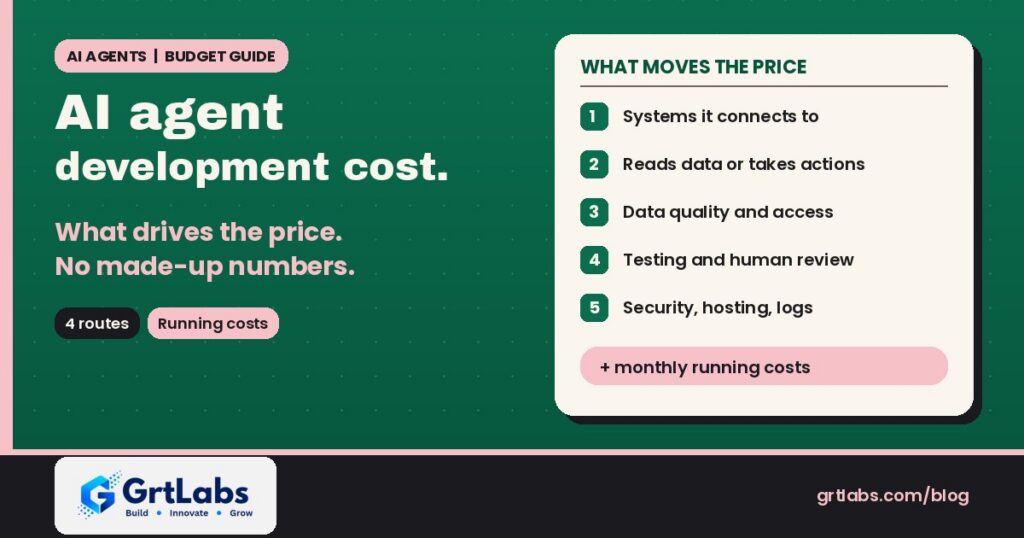
What drives AI agent development cost
Two agents with the same name (“support agent,” “order agent”) can differ a lot in effort. These are the drivers that matter most for AI agent development cost:
- Number of systems it connects to. Each API, database or document store is an integration to build, test and keep working. One CRM is simpler than a CRM, an ERP and a shared drive.
- Read-only vs taking actions. An agent that looks things up is cheaper than one that updates records, sends messages or moves money. Actions need permissions, approval steps and rollback plans.
- Data access and quality. Clean, reachable data is cheap. Data spread across inboxes, PDFs and old systems needs extraction and cleanup first.
- Accuracy bar and testing. A draft that a person always reviews needs less testing than a step that runs on its own. Building an evaluation set of real examples is part of the cost.
- Human review screens. If people approve or correct the agent’s work, someone has to build the review queue and the rules that send items there.
- Security, identity and hosting. Single sign-on, per-user permissions, running inside your own AWS or Azure account and protecting against prompt injection all add design and build time. See how to give AI agents real access safely.
- Logging and audit needs. Regulated or sensitive work needs a durable record of every step the agent took and every approval a person gave.
- One agent or several. Multiple agents handing work to each other cost more to design, test and monitor than one agent with a short tool list.
Notice what is not on the list: the model itself is rarely the biggest build cost. The work is in the integrations, the guardrails and the testing. If an agent is not the right shape at all, a simpler tool may do the job; compare AI chatbot vs AI agent and AI agents vs RPA before you scope.
Running costs after launch
The build is a one-time line in your AI agent development cost. These keep coming every month:
- Model usage. Model APIs bill by tokens, the pieces of text the model reads and writes. Providers such as Anthropic and Amazon Bedrock list input and output tokens at separate prices, so long prompts, big documents and chatty multi-step agents cost more per run.
- Discounts you can design for. Both pricing pages offer lower rates for work that does not need an instant answer (Anthropic: “Save 50% with batch processing”; Bedrock: batch inference “at a 50% lower price compared to on-demand” for select models) and cheaper reads of cached prompts. A smaller model can also be enough for narrow steps; see small language models.
- Hosting and storage. The servers, queues, databases and search indexes the agent runs on.
- Monitoring and evaluation. Dashboards, alerts and re-running your test set after every change. Our LLMOps guide covers what this looks like.
- Upkeep. Models get retired and APIs change. For example, Anthropic set a retirement date for Claude Sonnet 4.5 on its API; see what to check before a model retires. Someone has to re-test and switch.
- The owner’s time. A person on your team reviews exceptions and decides what to improve next. That time is real cost.
Ask every vendor for an estimate of monthly running costs at your expected volume, and set a budget alert in your cloud account before the first production week.
Why the pilot is the cheap part
A demo that works on a handful of examples is not a production agent. Moving to production usually adds:
- A test set of real cases that runs every time the prompt, model or tools change
- A cost ceiling and alerts so one bad loop does not run up the bill
- Monitoring that tells a person when the agent fails, before customers notice
- A fallback when the model or provider is down, and a way to roll back a bad change
- Handover documentation and training for the people who will run it
Budget for that production layer up front, or the second invoice will surprise you. The NIST AI Risk Management Framework is intended for voluntary use and is a useful checklist for what “production ready” should mean for your risk level.
How to get a reliable AI agent quote
Vendors can only price what you describe, so the clearest way to pin down AI agent development cost is a clear brief. Bring this to the first call:
- One workflow in one paragraph: what starts the work, the steps a person does today, the systems touched, and what “done” looks like.
- Real samples: a set of actual tickets, documents or records, including messy ones.
- A systems list: every app the agent must read from or write to, and whether each has an API.
- Approval rules: which actions the agent may take alone and which need a person.
- Where it must run: a vendor’s cloud, or inside your own AWS or Azure account. Our AWS Bedrock vs Azure OpenAI guide helps here.
- Volume you know today: how many runs a day or month, from your own records.
Then ask for line items: discovery, build, integrations, testing, deployment, training and monthly running costs, listed separately. A single lump sum hides where the money goes. Our checklist on choosing an AI development company has the questions to ask about code ownership, logs and support.
When not to build a custom agent
- The task already fits a tool you pay for, with its built-in connectors.
- No one on your team will own the agent and review its exceptions.
- The process changes every week, so there is nothing stable to automate yet.
- A fixed rule or script would do the job; you do not need judgment at each step.
- You cannot get access to the data or systems the agent needs.
In those cases, spend first on fixing ownership, access or the process itself. Our AI implementation guide covers picking a first use case that is ready.
How GrtLabs scopes AI agent development
GrtLabs Inc is an AI and software development company based in Houston, Texas, founded in 2019. Under our AI Factory we build agentic AI, AI automation, AI assistants and the cloud setup they run on.
Our answer to “how much does it cost?” is the same one on our Houston AI development page: it depends on the use case, the data involved and the systems we need to connect. That is why we start with AI Discovery, a focused 2–3 week engagement that ends with use cases ranked by value and feasibility, clear build or no-build recommendations, and a recommended proof of concept. The roadmap is yours whether or not you build with us.
- We start small, prove the result on your own data, then expand.
- Agent design covers goals, tools, permissions and escalation rules, with human-in-the-loop approval steps and logging.
- On AWS / Azure AI we deploy inside your cloud account, right-size services, set up monitoring and budgets, and review usage with you.
- We hand off with documentation and training for the people who will run it.
Want a real estimate for your agent? Talk to our Houston team or start with AI Discovery.
Frequently asked questions
How much does AI agent development cost?
It depends on the route you choose and how much the agent has to touch: the number of systems it connects to, whether it only reads data or also takes actions, the quality of your data, your accuracy bar, and your security and logging needs. Get a scoped quote with line items rather than relying on a general price band.
What makes an AI agent more expensive to build?
More integrations, write access to business systems, messy or hard-to-reach data, a high accuracy bar, human review screens, single sign-on and per-user permissions, hosting inside your own cloud, audit logging, and multiple agents handing work to each other.
What are the running costs of an AI agent after launch?
Model usage billed by input and output tokens, hosting and storage, monitoring and evaluation, upkeep when models are retired or APIs change, and the time of the person who owns the agent. Batch processing, prompt caching and smaller models can lower model usage.
Is it cheaper to use an off-the-shelf AI tool?
Often, yes, when the job fits the tool’s built-in connectors and rules. Custom development makes sense when the process crosses several systems, needs your own permissions and approvals, or must run inside your own cloud account.
How do I get an accurate AI agent quote?
Describe one workflow in a paragraph, share real samples, list every system the agent must touch, state which actions need approval, say where it must run, and share the volume you see today. Ask for discovery, build, testing, deployment, training and monthly running costs as separate line items.
How does GrtLabs price AI agent work?
Cost depends on the use case, the data involved and the systems we need to connect. We usually start with AI Discovery, a 2 to 3 week engagement that ranks use cases and recommends a proof of concept, so you can see what is worth building before committing to a larger project.
