
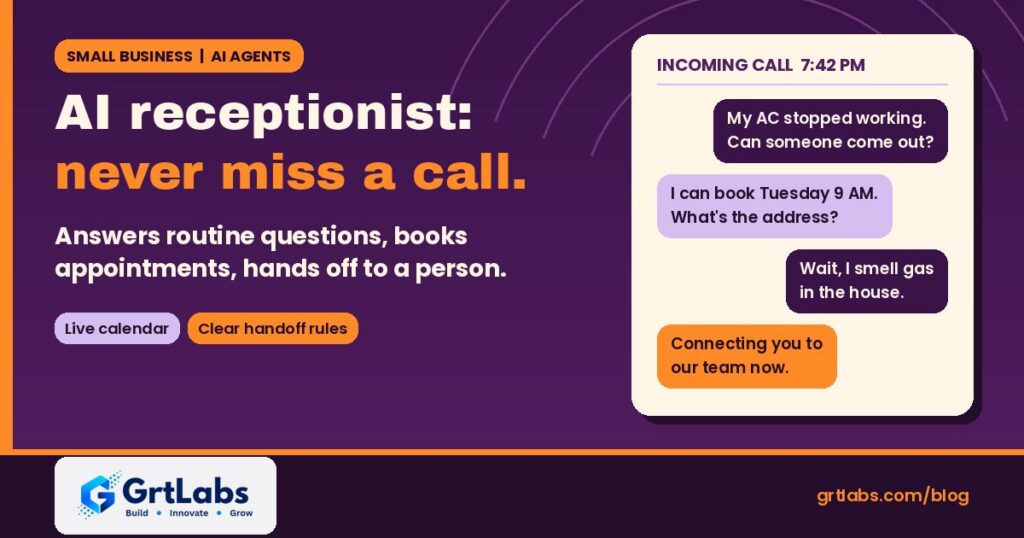
AI Receptionist for Small Business: What It Answers and How Handoff Works
AI Receptionist for Small Business: What It Answers and How Handoff Works https://grtlabs.com/wp-content/uploads/2026/11/featured-ai-receptionist-1024x538.jpg 1024 538 Nadeem Shaikh https://secure.gravatar.com/avatar/459d5135d86aff60790fdf4d25ee6958e526211d5cd43d190b1516158cf9feba?s=96&d=mm&r=gAn AI receptionist for a small business answers your phone or chat when nobody is free, handles the routine questions (hours, location, services, how to book), takes the caller’s details, books or requests an appointment in your calendar, and passes anything urgent, unclear or sensitive to a real person. It works well when it has a short, accurate script of facts about your business and a clear handoff rule. It goes wrong when it is left to guess.
This guide is for owners and office managers at home service companies, clinics, law and accounting firms and other small businesses that miss calls during busy hours or after closing. It covers what an AI receptionist can answer, how booking and handoff to a person should work, what drives the cost to run one, and the mistakes to avoid before you switch it on.
What an AI receptionist actually does
An AI receptionist is an AI agent connected to your phone line, website chat or text messages. It listens or reads, works out what the person wants, answers from information you gave it, and takes a small number of actions in your tools, such as checking open time slots or creating a lead in your CRM. Unlike an old phone menu, the caller just says what they need in their own words.
| Usually a good fit | Usually hand to a person |
|---|---|
| Business hours, address, parking and service area | Emergencies and anything safety-related |
| Which services you offer and how to request a quote | Complaints and upset customers |
| Booking, moving or cancelling a standard appointment | Pricing exceptions, discounts and disputes |
| Taking a message with name, number and reason for the call | Medical, legal or account-specific questions |
| Collecting job details before a callback (address, issue, photos by text) | Anything the script does not clearly answer |
The difference between this and a website chatbot is mostly the actions. A chatbot answers questions; an agent can also book, update and hand off. Our AI chatbot vs AI agent guide explains where that line sits.
How booking works
Booking is where an AI receptionist saves the most time and causes the most trouble if it is set up loosely. A safe setup looks like this:
- Connect to your real calendar or scheduling tool, not a copy, so it only offers slots that are actually open.
- Set booking rules in writing: which services it can book, how long each one takes, lead time, buffer between jobs, and which service areas or locations each team covers.
- Confirm details back to the caller (date, time, address, service) before it books.
- Decide what it may change. Many businesses let it book and move standard appointments but send cancellations of large jobs to a person.
- Log every booking with the call summary in your CRM or job system, so your team sees what was promised.
If your scheduling tool has no way to connect, start with “request an appointment”: the AI collects the details and your team confirms. It is slower but much safer than letting it guess at availability.
How handoff to a person works
The handoff rule matters more than the voice or the script. Write down exactly when the AI stops and a person takes over:
- Always transfer or alert immediately for emergencies, safety issues and callers who ask for a human.
- Take a message and notify for anything it cannot answer from your information, with the caller’s name, number and a short summary.
- Tell the caller what happens next, for example “Someone from the office will call you back today,” and only promise what your team really does.
- Route by topic so billing questions reach billing and service problems reach the right manager.
- Review missed handoffs weekly. A quick look at call summaries shows where the AI should have passed the call on.
Callers forgive talking to an AI. They do not forgive being stuck in a loop with no way to reach a person.
What it costs to run
We will not quote a number here, because the price depends on your setup. These are the things that drive it:
- Channels: phone calls cost more to run than chat or text, because voice adds speech recognition, speech generation and telephony charges, usually billed per minute.
- Call volume and length: most running costs scale with how many conversations it handles and how long they last.
- Integrations: connecting to your calendar, CRM, job management or practice software is where most of the build effort goes.
- Off-the-shelf or custom: a ready-made AI receptionist service is quicker to start; a custom build fits unusual booking rules, several locations or your own systems.
- Upkeep: someone has to keep hours, services and handoff rules current and review calls.
For a fuller breakdown of build and running costs for AI agents, see AI agent development cost: what drives the price.
Where AI receptionists go wrong
- Making things up. Without a clear script of facts, it may invent a price, a policy or an opening. Tell it to say “I’ll have someone confirm that” instead of guessing.
- Double bookings from a calendar that is not connected live or rules that are not written down.
- No easy way to a person, which frustrates callers and loses jobs.
- Outdated information after hours, services or staff change.
- Taking odd instructions from callers. A caller can try to talk it into a discount or into revealing information. Limit what it can do and read our guide to prompt injection protection.
- Collecting sensitive details it does not need, such as full card numbers or medical history. Keep the intake to what the callback needs.
How to launch one safely
- Write a one-page fact sheet: hours, services, service area, booking rules, and who handles what.
- Write the handoff rules from the section above.
- Start with one channel (often after-hours calls or website chat) and one or two call types.
- Test it with 30 or so real call reasons your office already gets, including the hard ones.
- Tell callers they are speaking with an AI assistant, and follow the rules for recording and disclosure where you operate.
- Review summaries every week for the first month, then fix the fact sheet and rules.
If you are choosing a first AI project in general, our AI implementation guide walks through picking and piloting one use case.
How GrtLabs builds AI receptionists and front-desk agents
GrtLabs Inc is a Houston-based AI and software development company, founded in 2019. Through our AI Factory we build AI agents and AI assistants that answer from your own information, take actions in the tools you already use through automations, and hand off to your team with a clear summary. Every agent has guardrails, human approval steps where you want them, and a log of what it did.
Most projects start with AI Discovery, a short engagement that scopes the first use case, the systems to connect and the handoff rules before you commit to a build. Houston businesses can also see our AI development company in Houston page.
Missing calls during busy hours? Talk to our Houston team about an AI receptionist built around your calendar, your services and your handoff rules.
Frequently asked questions
What is an AI receptionist?
It is an AI agent connected to your phone line, website chat or text messages that answers routine questions, takes caller details, books or requests appointments and hands urgent or unclear calls to a person.
Can an AI receptionist book appointments?
Yes, when it is connected to your real calendar or scheduling tool and has written booking rules for services, durations, buffers and service areas. If your tool cannot connect, it can collect the details as an appointment request for your team to confirm.
How does an AI receptionist hand a call to a person?
You set handoff rules: transfer or alert immediately for emergencies and callers who ask for a human, and take a message with a summary for anything it cannot answer. It should tell the caller what happens next.
How much does an AI receptionist cost for a small business?
It depends on the channels (voice usually costs more to run than chat or text), call volume and length, the systems it connects to, and whether you use a ready-made service or a custom build. Upkeep and call reviews also take staff time.
Will customers know they are talking to an AI?
They should. Tell callers they are speaking with an AI assistant, offer an easy way to reach a person, and follow the recording and disclosure rules where you operate.
Is an AI receptionist right for my business?
It fits best when you miss calls during busy hours or after closing, most calls are routine questions or bookings, and you have a clear process for callbacks. If most calls need judgment, start with message-taking and after-hours coverage.
